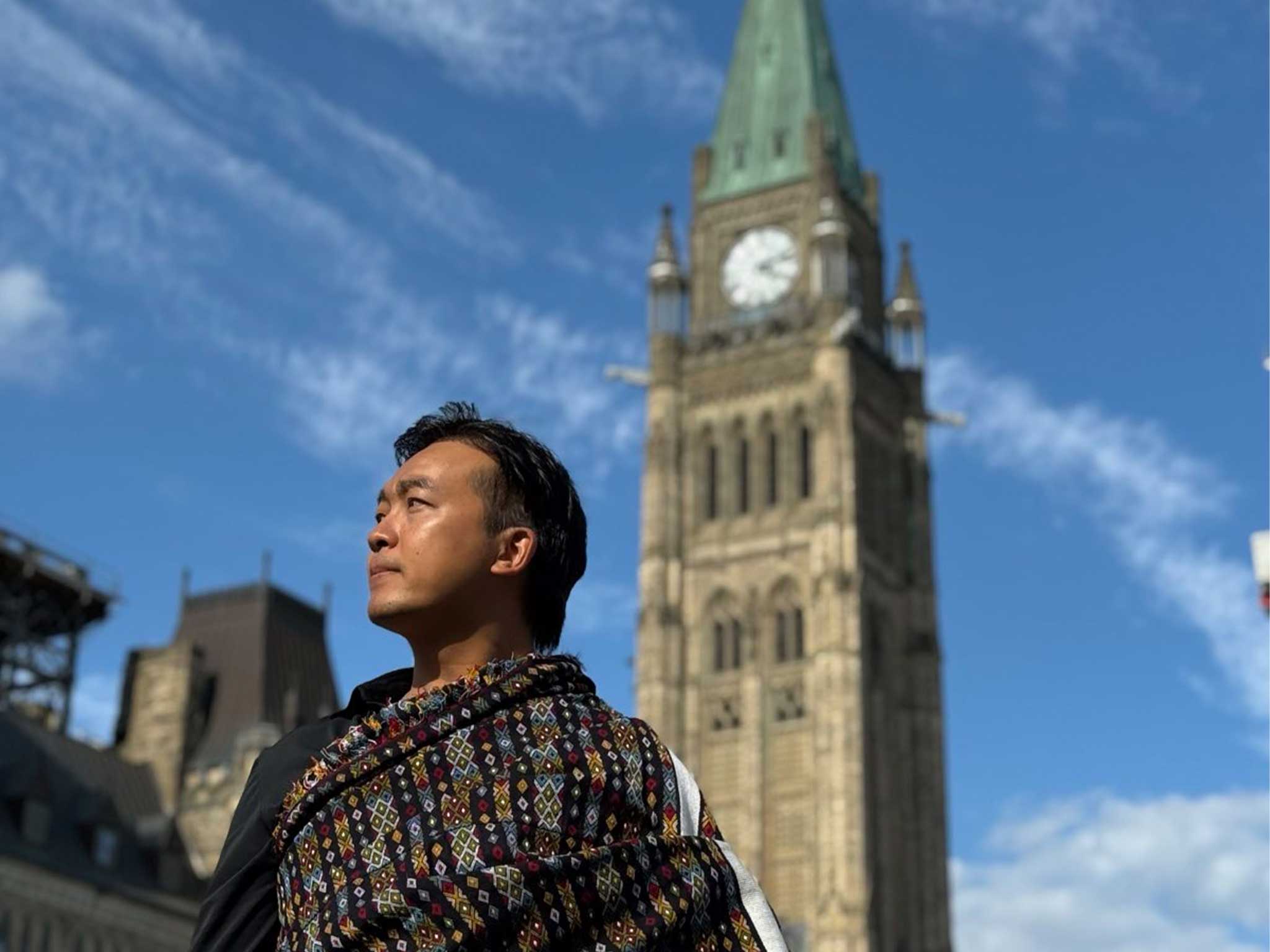
Dr. Lian, Health Secretary for Chinland, visited Ottawa as part of a counterpart health tour in September 2025.
Photo: Burma counterpart
Meanwhile, decades of dictatorship and patriarchal norms have limited who has access to health care and who shapes health policy.
Dr. Lian sees these challenges first-hand as health secretary for Chinland, a self-declared autonomous state and traditional homeland of the Chin people in western Burma. In the wake of the coup, Dr. Lian helped develop Chinland’s first-ever health policy.
In September 2025, we brought Dr. Lian, and other health leaders from Burma we support, to Canada to meet with health organizations—including our counterpart, Canadian Health Coalition. They exchanged ideas on inclusive approaches to care that now feed into our Burma counterparts’ efforts to build health systems from the ground up.

Support feminist health care with autonomy, dignity and rights at its core.

In Burma, the health system has been very top-down. Authorities don’t understand the context of different peoples, geographies or genders. In Canada, each province has its own health policy that reflects its culture, geography and population. Instead of authoritarian mandates, there are negotiations and discussions to find better solutions.
My main takeaway is that there is no perfect public health system. Public health is a long process of finding the best solutions through learning and adapting.
I grew up in a very patriarchal society where most leaders and breadwinners are men, and many women don’t know their rights when it comes to their own health. Too often, a man decides about a woman’s health. For example, a wife has to ask permission from her husband to use family planning. That is really sad, and it is one of the reasons I advocate for women’s health.
I work with many young Chin women, and each time we sit together, their perspectives often change our plans for the better. Our health minister is a woman. Her leadership style and mediation skills are very effective in a conflict- sensitive situation. She is not only shaping public health planning but also becoming a role model for many young girls and women in Chinland.
Our Chinland interim health policy is one step toward a fair, inclusive, minority-representative health system and toward federal practice in the health sector. As I learned in Canada, it is a long process of negotiation: staying firm on the principles of federalism, human rights, equity and diversity. It also has to be a huge team effort: well-planned and well-coordinated across sectors. The journey to a federal, inclusive health system is long, but step by step, if we all jump in together, I believe we can reach it.
In your February Bulletin, our counterparts show us what a feminist approach to health looks like in practice.