


May 1, 2026
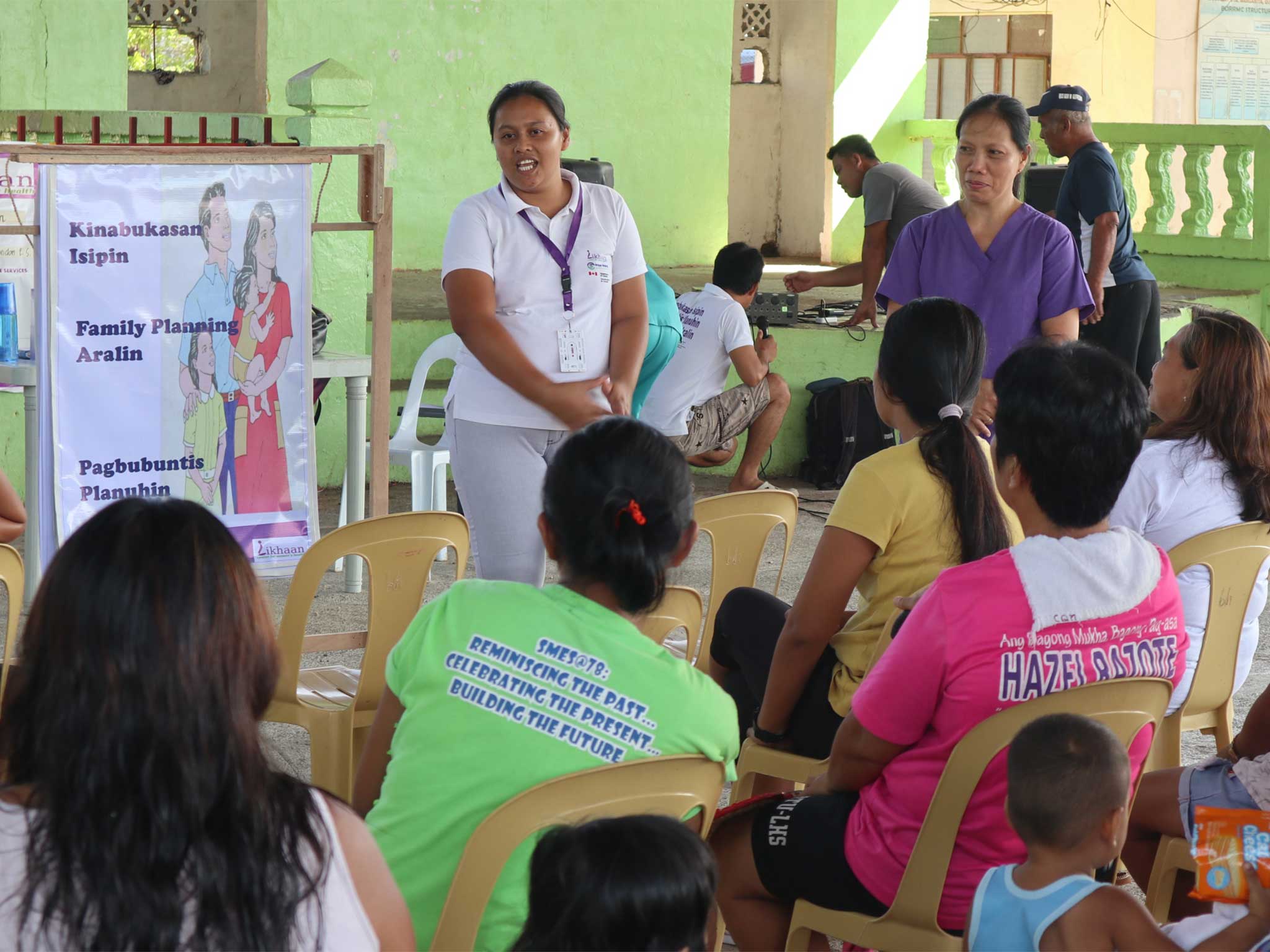
Jayza and Melba lead a community health education session with women in Eastern Samar, the Philippines. Photo: Likhaan
Photo: Likhaan
Jayza is a community health worker with Likhaan Center for Women’s Health. She was going door-to-door to talk to women about sexual and reproductive health. This information was hard to get after the disaster. No one else was offering it.
“We often had the door shut in our faces,” recalls Jayza. “More than having ups and downs, it was a case of downs and downs.”
Women were wary of the information Jayza was trying to share.
Jayza’s job would be tricky. Reproductive health care has a complicated reputation in the Philippines.
Religious leaders have long condemned reproductive health care and spread misinformation about birth control. Family planning programs have track records of treating women poorly and not sticking around very long. Men control most households, often making decisions about their wives’ bodies and health.
But Jayza knew the information she had to share was important.
Likhaan had just opened a clinic in Eastern Samar, offering free sexual and reproductive health services. To shape the clinic’s services, Likhaan sought input from nearby grassroots women’s groups and locals like Jayza. This is still how the clinic works today—and how Likhaan ensures what they offer is what the community needs.
It would take time for Jayza and other community health volunteers to build trust with women in Eastern Samar. They knew it was possible, though. Likhaan had done it many times before.
But it would take patience, respect and follow through.
Likhaan started providing health services in Manila, the capital city, in 1995. The founders wanted to offer a different kind of health care in impoverished areas: one rooted in community, with an emphasis on women’s health.
Likhaan has since grown to run nine clinics, including the one in Eastern Samar. The clinics provide holistic support for sexual and reproductive health, including contraceptives, care during and after pregnancy, cervical cancer prevention and treatment, sexually transmitted infection testing and treatment, post-abortion care and support for survivors of gender-based violence.
Most importantly, Likhaan’s services are free. Anyone can access care through Likhaan based on need—not ability to pay.
The patience and persistence of health promoters like Jayza paid off: Likhaan eventually earned women’s trust in Eastern Samar. Word spread across the island about Likhaan and its free, high-quality services. Community outreach is still an important piece of what Likhaan offers. But it’s different now.
“No more doors are shut in our faces,” Jayza shares.
Community health workers are welcomed and confided in.
Article continues below.
Become a monthly supporter of women’s health
Health care is most impactful when it is rooted in local expertise, community and trust.
By becoming a monthly donor, you provide steady support for organizations like Likhaan to take the time they need to set up—and stay—in communities that need care the most. And you help ensure women like Lorena have reproductive health care access with community health workers they can trust.
Become a monthly donor today.
Melba, a midwife, started working with Likhaan around the same time as Jayza. She and Jayza were once visiting a patient living in a rural village. Lorena* had several children and was at an age when another pregnancy would be risky. Lorena told Melba and Jayza that her husband had refused to let her use birth control. So Lorena took birth control pills in secret. When her husband discovered this, he threw away Lorena’s pills and abused her.
After learning this, Likhaan offered Lorena birth control injections—a method her husband can’t detect.
On an island like Eastern Samar, where women are isolated and cannot easily access services or support, Likhaan’s community outreach is a lifeline.
Inter Pares has supported Likhaan’s work with women, youth and LGBTQI+ communities for more than 30 years.
Over the decades, our collaboration has deepened. In 2026, we started supporting Likhaan to increase their financial sustainability and pilot their innovative public health-care model with allied organizations. The Canadian government has funded our work with Likhaan since its founding in 1995.
In the coming years, Likhaan will introduce new services to their clinics. They’ll also help women, youth and LGBTQI+ people register with the Philippines national health insurance program. This will help more people access free health services. We’ll also be supporting Likhaan’s training for adolescent volunteers. These volunteers will go on to teach their peers about sexual and reproductive health and rights, expanding Likhaan’s public education.
Jayza and Melba have seen big changes in Eastern Samar since Likhaan arrived in 2013. But there is still much to do.
A lot of families still do not have money to pay for health care or transport to free clinics. Often, men’s attitudes haven’t changed much. Many are still opposed, sometimes violently, to contraception.
Despite the heavy and emotional challenges of their work, Jayza and Melba are determined to carry on.
“We will not stop,” asserts Melba. “This work is too important. We will keep helping women to take more control of their lives.”
*Name changed to protect anonymity
Become a monthly donor today.
Inter Pares acknowledges Global Affairs Canada for its financial support for our work with Likhaan in the Philippines.